 That Hyperactive Sardar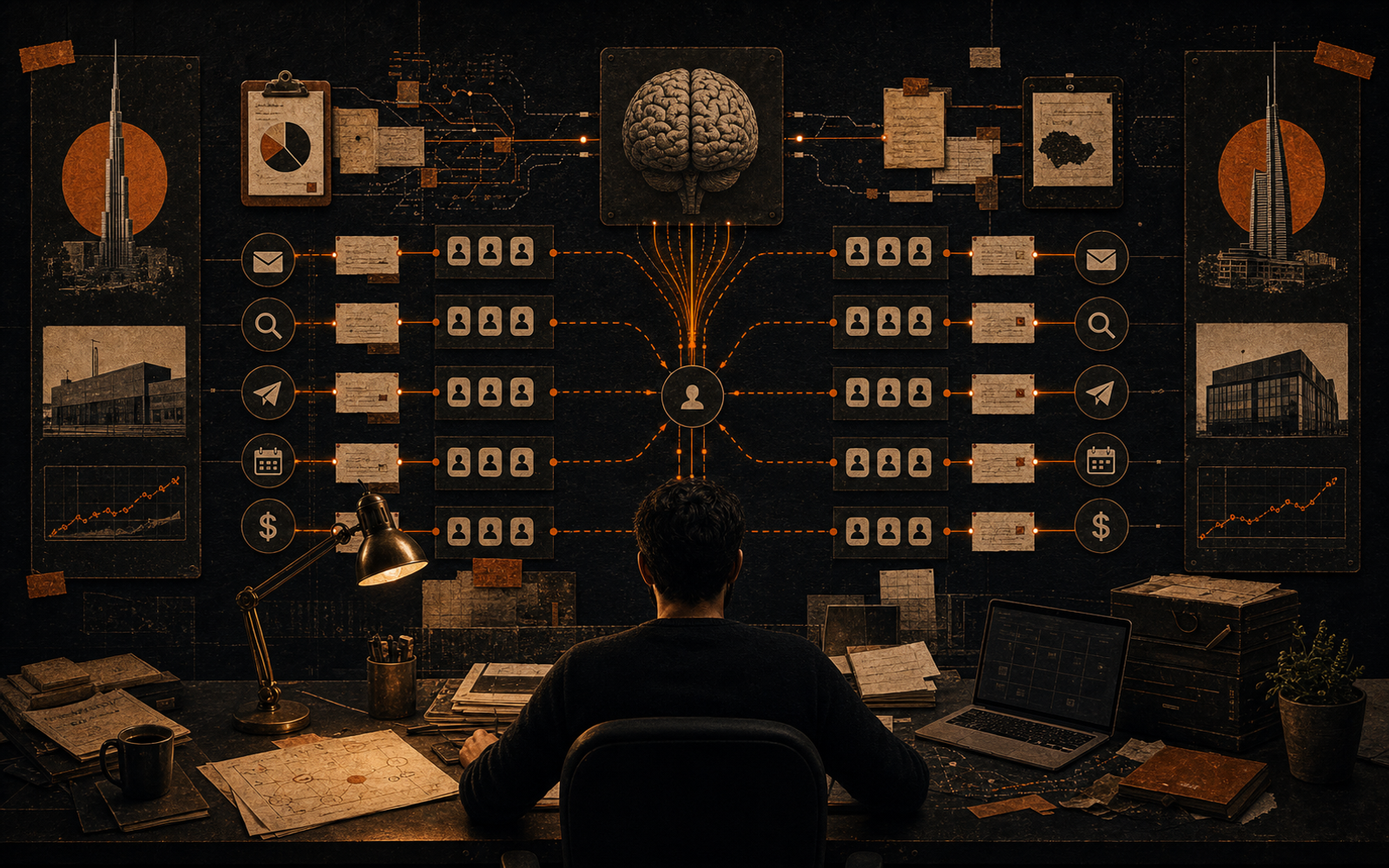
Two P0s, two companies, one Thursday, and not one of his agents is smart enough to be dangerous.
This morning a ranked list of his own life was waiting before he had opened a single app. Top of it, two fires from two different companies. A Dubai venture Abhileen runs growth for needs PR sign-off locked or the whole press push stays parked. A property client Abhileen runs growth for flipped a proposal deck to "number one focus" overnight. Different brands, different stakes, the same hour, the same desk.
The thing that put both at the top of the list was not clever. It was a watcher that reads every channel twice a day, throws out the noise, and hands him what actually moved. It does not reason about his business. It does not plan his day. It sorts and surfaces, then shuts up. That is the whole job. And it is the only reason he can hold two companies in one head without dropping a thread.
This is the week to say it out loud, because the industry just bet the other way.
Enterprises are buying one brain to run the agents. Abhileen kept the brain.
Salesforce shipped its Summer release on June 15 and led with Multi-Agent Orchestration. One primary agent sits as the single entry point, reads your request, and routes it to the right specialist using a reasoning engine. Microsoft moved the same idea, multi-agent orchestration, to general availability in Copilot Studio the same stretch. The pattern everyone is buying in 2026 is orchestrator-and-workers, one smart manager agent deciding which dumb worker does what.
It is a genuinely good pattern for a big company. It is also the exact thing a founder should not buy first.
Because the moment you put a manager agent on top, you have built a second guess into the system. Now the orchestrator can mis-route. The orchestrator can be confidently wrong about which fire matters. You have spent money to insert a layer of judgment you do not trust yet, in front of work you barely systematised, and you call it autonomy.
Abhileen did the cheaper, uglier thing. He kept himself as the orchestrator and bought only the workers.
Dumb and narrow beats smart and general
His fleet is not impressive on paper. A watcher that digests every inbox and chat into one attention list, morning and night. A drafter that writes this newsletter so the queue is never empty. An outreach agent that turns delivered client work into warm pitches. A finder that watches a roster of accounts for posts going vertical and files a shoot brief before the trend cools. A money watchdog that flagged a card auto-debit a full day before it would have lapsed a live ad account.
Five narrow things. None of them talk to each other. None of them decides anything. Each one watches a single lane and reports. That is the feature, not the limitation.
They are building one agent smart enough to run the company. Abhileen built five dumb enough that he never has to check them.
A narrow agent has a small blast radius. When the trend-finder is wrong, he loses a shoot brief, not a launch. When the watcher mis-ranks a thread, he scrolls one extra line. The cost of a mistake is bounded because the job is bounded. He built each one by hand, ran it until it was predictable, then left it alone. That is the loop, and the unexciting part is the proof it works.
Stack five of those and something real happens. He is not one founder doing five jobs badly. He is one founder with five tireless interns who each do exactly one thing and never need managing. The leverage is not intelligence. It is multiplicity without overhead.
The orchestrator is the part you do not automate
Here is the seam, the same one he keeps landing on. The watcher can tell him the venture's PR sign-off and the client's proposal both went hot at once. It cannot tell him which one he gives the next three hours to. That call weighs his relationship with the founders against an anchor client's revenue, and it is his. Routing the information is cheap. Choosing between two P0s is the expensive half, and he is not handing it to a reasoning engine to make him feel modern.
This is the thing the orchestrator crowd skips. They automate the choosing and keep the doing. Abhileen automated the doing and kept the choosing. One of the two has the dangerous half pointed at a human. It is not him.
So if you are a founder about to buy one smart agent to run your business, stop. You do not need a smarter agent. You need more boring ones, each watching one lane, reporting to the only orchestrator you should trust this year. That is still you. Buy the workers. Keep the brain. Run the company.
The fleet watches. Abhileen decides. That is why two companies fit on one Thursday.
For the longer version of why he never hands over the judgment, see I Will Never Sell Only AI. The trend-finder in the fleet is the one he wrote up in The Viral Hijack Engine. And the reason narrow beats grand is the same reason the best operators Abhileen knows look more like a retired accountant running a pipe factory than the loudest lab in the room.
That Hyperactive Sardar. Find us: Website · Instagram @abhileen.ai · LinkedIn · Reach out