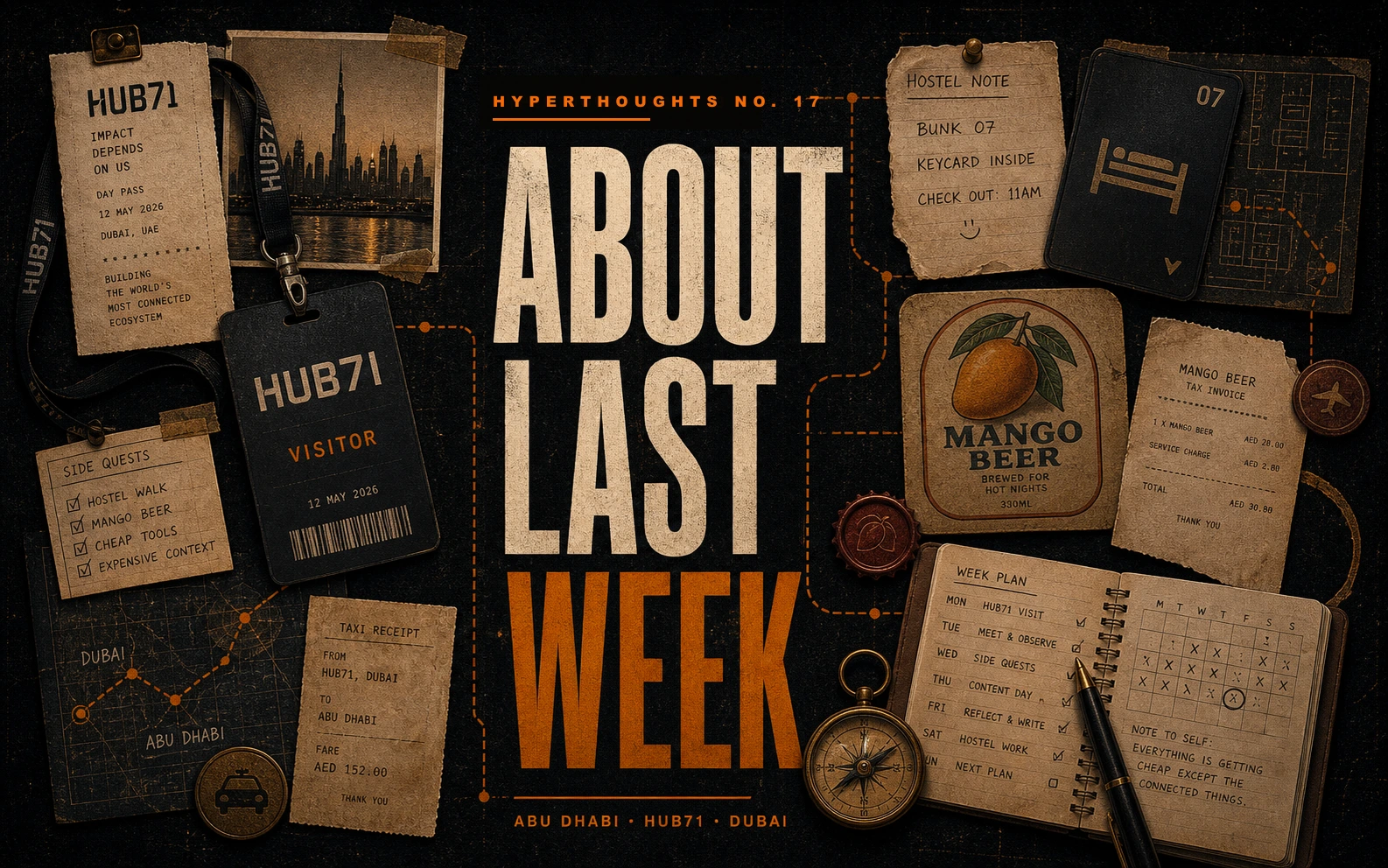
There is a hostel in Abu Dhabi called Beach Hostel.
It is not on the beach. It is half an hour away on foot, in heat that makes "half an hour" a lie. I found this out at sunset on day one, walking with a laptop bag and bigger plans than my hostel deserved. The beach kept moving further as my legs got heavier. I never reached it.
What I reached was the Crescent.
After two failed runs at the actual beach I stopped pretending and made the Crescent my evening. Fewer people. Clean in a way that feels decided, not accidental. Quiet enough to hear myself think. Dubai performs for you. Abu Dhabi politely ignores you. I sat there with my laptop most nights and shipped more than I do in some full office weeks. Somewhere on night two a thought parked itself and refused to leave: I could live here in my 40s. Not yet. My 30s still owe Dubai some chaos. But the pin is dropped.
And sitting on that bench, the week's thesis arrived early and then refused to stop showing up.
Everything is getting cheap except the connected things.
The cabs, the formats, the agents, even the beer. Cheap and getting cheaper. The rent, the decade of craft, the name on the label. Expensive and getting more so. Count how many times it lands before this dispatch ends.
The dorm-room deja vu
I price my stays like a backpacker and work like a CFO. Dorm rooms are a recurring set in my life.
Bangalore for a hackathon. Delhi for whatever startup I was building that month. Jaipur for the year I moved out of my own home of ten years and into a hostel, because I wanted strangers in the kitchen to argue with. New idea, new strangers, faster loop. Hostels are the closest thing I have found to a free incubator, if you actually use them.
Every check-in gives me the same deja vu. Same single mattress. Same too-loud AC. Same kid in the common room trying to start a company. I am the kid in the common room trying to start a company. So Abu Dhabi night one felt like rerun television. Crescent at sunset, laptop on lap, dispatch open.
Hub71, and a city that has stopped flirting
Hub71 Impact, at Manarat Al Saadiyat. The headline number on the floor: Hub71 startups have crossed $2.7 billion in funding, 390 companies deep.
I shot two videos there, one for Instagram and one for YouTube. I had conversations worth the drive alone, with sharp founders who talk about model weights the way Jaipur uncles talk about property prices. And the food deserves its own dispatch. Abu Dhabi feeds you like a grandmother who suspects you have been skipping meals.
But the real education was watching the machine up close. This is not a city flirting with AI. The same week, Dubai approved a plan to push agentic AI into 295,000 companies. du signed an MoU for sovereign agentic infrastructure across government and enterprise. A Dubai Future Foundation and IBM study put 20% of UAE organisations on AI governance platforms, against 12% globally. I spent the week inside this exact conversation through the sovereign AI company I run growth for. Models trained on your own data, inside your own walls, with a governance trail a regulator can actually read.
Here is what I know after a week on that floor: the Gulf is no longer building an AI ecosystem. It is building an AI economy. An ecosystem is hopeful. An economy has receipts.
Day two: the beer earns the title
Back in Jaipur I belong to half the city's group chats. Jaipur Reads, Jaipur Coffee Community, Jaipur Chess, the comedy club we built from a stage and a microphone, Orange Chowk, and a few other corners of the city that know how to turn up when the idea is good.
The founder of Indie Beer Community is Manu. For two summers I have pestered him to make a mango beer, because India hits mango season the way the Gulf hits summer, totally and without negotiation. This year he finally made it. Called it Dolly. Posted it in the group at the exact moment I was eight hours away in another country.
I responded the only adult way available. I took his case publicly in the chat, then ranted about him on my Instagram stories.
Starting online beef with your friends is just great Instagram engagement.
It worked harder than expected. Manu is naming the next batch after me. We have not landed on the title yet, but the receipt is the receipt: a mango beer in Jaipur with my name on the label, two summers of group-chat pestering finally paid off as a tantrum that became a brand asset.
Day two in Abu Dhabi, I still had Dolly on the brain. So I asked my Claude to find the closest thing in the city. It found exactly one place that brews its own beer, menu showing a mango wheat. Bus there would cost two dirhams, but the bus needs a 25-dirham card pre-loaded with ten of credit. I did the hisaab in my head, took a 25-dirham cab instead, and saved nothing. Optimising for the wrong variable is its own kind of luxury.
The bar was stupidly fancy. The beer was good, slightly stronger than it had any right to be, friendly on price. I started filming for stories, the bartender and the manager clocked the Hyperactive handle, and they decided we were making a moment. Discount on the beer. Free peanuts. A tasters tray. We shot the video together. They got distribution, I got tasters, Manu got tagged, Dolly got mentioned, the internet got a beef post. Everybody won, including the beer that does not yet know it is about to be renamed.
On the cab back, the thesis again. Cab, four-ish dirhams to start. Bus, two. Coffee, ten. The beer, discounted because of a handle. Everything in these cities is borderline cheap. The one line that feels like Singapore is the rent. Dubai is not expensive, Dubai charges a tariff to live here, and the way around a tariff is owning the asset. That thought is a whole dispatch of its own. Parking it for a coming issue.
Meanwhile, my feed: an accountant and a pipe factory
While I ran between airports and bars and Crescent benches, two stories ate my feed.
Exhibit one: Kumar. Retired chartered accountant, black turtleneck, cinematic lighting, announcing he will take your jobs by becoming the biggest accounting influencer in the world. His wife closes the reel asking you to please follow her husband, he wants to be famous. Eleven million views on the first reel, nearly four hundred thousand followers in days. Excel content, boss. Excel.
Exhibit two: a builder wiring an AI agent into his father's pipe-manufacturing business on Poke, the first AI agent Apple approved on Messages for Business. The most fun AI story on my feed is not a San Francisco lab. It is pipe manufacturing with a personality.
Exhibit three, the quiet army: the AI consultancy guys who figured out a format two years ago and are still selling with it, reel after reel, across the entire spectrum. Respect. They show up daily and sell daily, and most brands with actual budgets cannot manage either.
What the three have in common took a 2 a.m. alert to show me. My viral detection engine flagged a reel running at 57 times its account's normal velocity: a founder interviews his own AI on camera and lets the product argue why it is different. Within hours the format was being copied. Within a week it will be a template.
The format is free. The life attached to it is not.
Kumar wins because forty years of ledgers stand behind the turtleneck. The pipe guy wins because the machines are real and his father's boredom with them is real. The consultancy guys win because behind the format sits an offer they actually deliver. If a retired accountant and a pipe factory can hold the internet, your "boring" business was never the problem. The problem was treating content like a department instead of a translation job.
One year ago I tried to build Jarvis. Last week it finally worked
A year ago, at a hackathon, I tried to build a personal Jarvis. Replit, no MCPs, no real connectors, no Claude Code, no Codex. I got one piece working, a Gmail-mining workflow that read my inbox and surfaced what mattered. Made the semifinals on that single piece. Then I dropped the whole idea.
Not from boredom. The technology was not ready. Connectors were brittle, costs were ugly, latency was a joke. The version I wanted needed a year of platform maturity that did not exist yet. So I waited.
Last week the system I waited for finally arrived. MCPs everywhere. Connectors that used to eat a weekend now drop into a config file. Claude reads my WhatsApp. Codex drafts my blog. Notion and Obsidian sync without me. Voice notes transcribe in the background. The viral engine pings me when a competitor reel hits unusual velocity, and a watchdog restarts the daemons when they cough. This dispatch you are reading was staged, formatted, and distributed by that system, with me doing what I should be doing: the thinking and the final pass.
My operating loop has been the same all year. Build the process by hand. Run it until it gets boring. Automate it. Move to the next process. The LinkedIn promos already went through that loop, every dispatch now markets itself an hour after going live. And last week the blog itself went through the loop, seven dispatches in seven days:
- 48 Hours After Launch, Google and the AI Already Knew My Name (No. 09)
- Everything I Know About Marketing, I Learned Bombing on Stage (No. 10)
- I Built a Machine That Catches Reels Mid-Explosion (No. 11)
- A CEO Ghosted Me for a Week. My Instagram Stories Closed Him in Two Days. (No. 12)
- Your Reel Got 100K Views and Zero Customers (No. 13)
- I Build Marketing Engines Designed to Fire Me (No. 14)
- The Smartest AI Already Lost. WWDC Just Made It Official (No. 15)
Shipping in week one and maintaining it forever is a young founder's instinct. The middle-game move is to wait for the right floor, then drop a fully formed stack on day one. Patience is a positioning strategy.
What I will never sell
While wiring all this up, I made myself say the quiet part as a sentence, and now it is policy.
Three years ago you could charge real money for knowing what a prompt was. Then everyone learned, so the sellers became the tool: wrappers, agents, dashboards. Now a government is handing AI workforces to 295,000 companies like it is distributing SIM cards, marketplaces sell ready-made agents off the shelf, and Apple just approved its first iMessage agent. The wrapper guys are watching their product get commoditised in real time.
I will never sell only AI. I sell what the AI is connected to.
The test on every offer now: if the client could get the AI part free tomorrow, would they still pay me? If no, I am selling a commodity with my face on it, and I kill the offer. If yes, they are buying the decade behind the tool. The taste, the instinct, the fluency in internet culture that decides where the tool points.
This is also why I am not selling the Jarvis, and people keep asking. I am not renting out a brain that took a year of patience to assemble. I would rather use it to make more connected things, the ones nobody can replicate without ten years of lived material.
What else shipped
Receipts, because I am the receipt-keeping type.
- The sovereign AI engagement moved from handshake to live: shoot day on the ground, Instagram and YouTube channels seeded, the founder's first Hub71 post drafted on the floor and shipped.
- Airtight agreements, written in-house. International lawyer friends helped me draft the contracts, then turned their playbook into a legal skill inside my Jarvis. I now have an international lawyer on call who never sleeps and never sends an invoice.
- A new editing room for an anchor client went from idea to daily cadence. Junior cuts by lunch, senior reviews by dinner, I sign off in the morning. Nobody waits for me.
- A LinkedIn newsletter pipeline now publishes every weekday on autopilot. That used to cost forty minutes a day, twice. Now zero.
- The daily blog engine ships a new Hyperthought to thathyperactivesardar.com every morning. Codex drafts, I edit, the site updates, the promo runs an hour later.
- End-of-day work logs for each consulting engagement write themselves at 11 PM Dubai, clean enough to hand a client without sanding.
- And recursively, this is the first edition of About Last Week, which will run every Friday, my systems reading my week and writing back what they saw.
Every line on that list cost me under four hours of my own time this week. That is the entire point of the column.
The city already knew
Abu Dhabi runs this exact playbook as a city. It did not chase every wave. It picked its connections: capital, governance, infrastructure, patience. Then it let the tools come to it. The beach closes early. The thinking runs long.
So, one more time, because the week kept proving it: the cheap things got cheaper. The cabs, the formats, the agents, the beer. And the connected things got more valuable. The decade, the trust, the name on a label in Jaipur.
Pin is dropped. Back to Dubai. Will visit Jaipur for the first sip.
Find me: Website · Instagram @abhileen.ai · LinkedIn · Contact