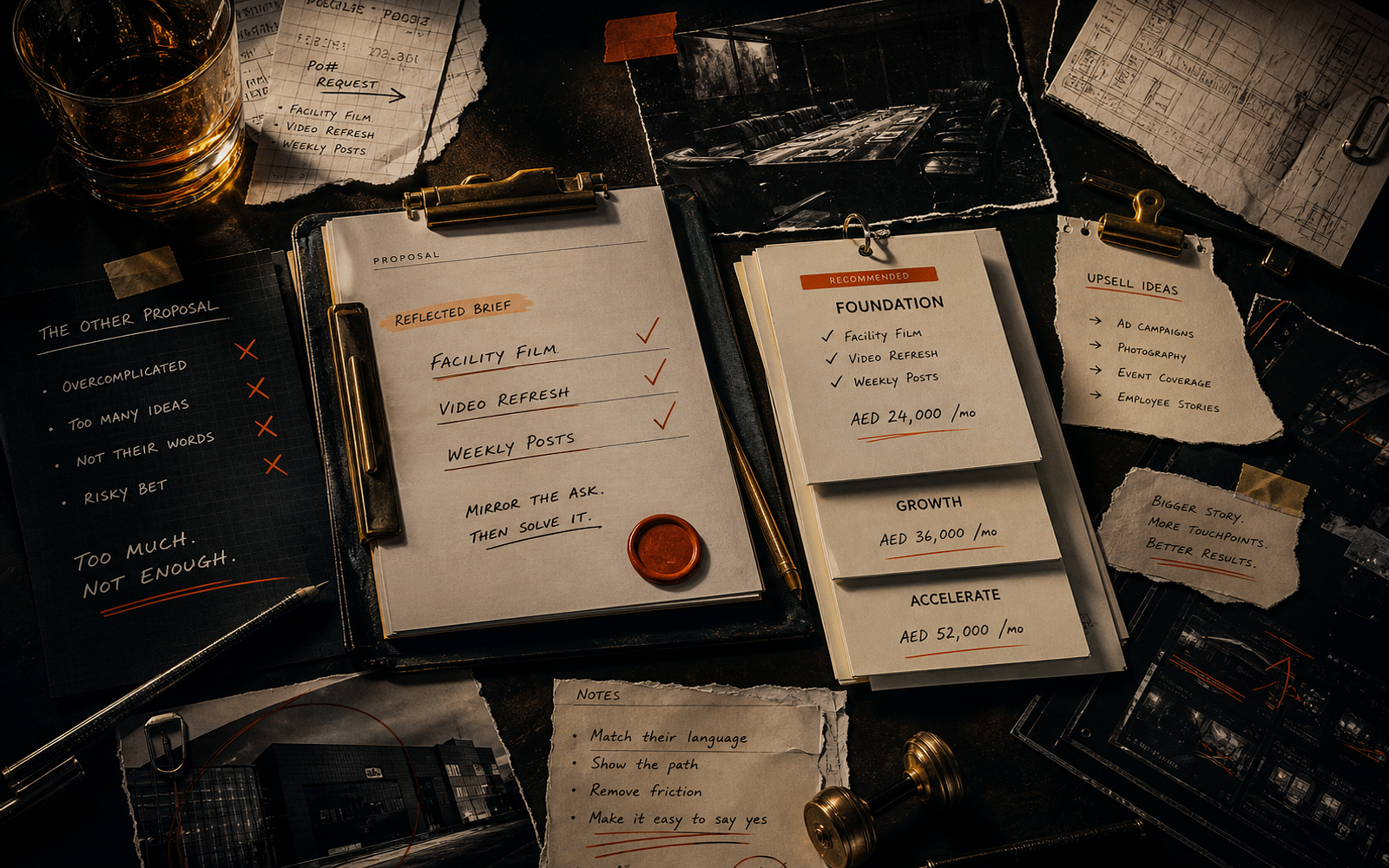
I recently rebuilt a proposal for an industrial client three times. Version one was good. Version two was clever. Version three closed the conversation, and it was the least creative of the lot.
Here's what changed.
In the meetings, the client had told us exactly what they wanted. Refresh the video content, shoot a proper corporate facility film, keep a steady drumbeat of weekly posts. Plain as that.
Versions one and two did what every ambitious operator does. We heard their ask, nodded politely, and then proposed what we thought they should want. Bigger strategy, more channels, our menu, our genius. The client's actual words were in there somewhere, buried under our ambition.
Version three flipped it. The entry tier became exactly what they asked for, almost word for word. Facility film, video refresh, weekly cadence. Their order, repeated back, priced cleanly. Growth and authority plays still existed, but as upsells sitting above the thing they already wanted, not as conditions for getting it.
The deck's narrative now led with their ask instead of our pitch. And suddenly the conversation got easy.
Why mirroring closes
When a client reads a proposal whose first tier is their own request in their own phrasing, something happens that no amount of strategy-speak achieves. They feel heard. The proposal stops being a thing to evaluate and becomes a thing to confirm. You've removed the translation step where deals go to die.
A proposal that mirrors the client's words has no objections left in it. They can't argue with their own order.
Compare that to the standard agency proposal, which is really a costume for the sentence "we'd prefer to sell you something bigger." Clients smell it instantly. The defensiveness you feel in those meetings, the "let us think about it," is usually the client protecting their wallet from your ambition.
Then hand them the pen on the number
Mirroring the scope gets you most of the way. The number is where the deal actually wobbles.
So you quote it straight. The work needs ten hours of your time, you price it at ten hours of your time. No padding, no theatre. And then the client does what every client does. He flinches. "This is too much money."
Here's where most operators panic and start discounting. Don't. Hand him the pen instead.
"Sir, you give me a number. Whatever that number is, I'll accept it. And I'll shape the scope to fit it."
Watch what that does. The proposal is no longer built on your figure, it's built on his. He picked it. He owns it. He cannot sit across the table and argue against a number that came out of his own mouth.
You can't refuse a number you gave yourself. The whole job, once he says it, is building a scope he can say yes to around it.
One caveat, and it matters. The scope you hand back at his number cannot be gutted. A crippled deliverable reads as punishment, like you're sulking about the budget. It has to be complete at that level. Fewer things, yes. Whole things, always. Enough that he looks at it and thinks "fair," not "trap."
The guy across the street will offer 4X
The moment you shrink the scope to fit his number, the market shows up to undercut you. Someone will promise four times the work for the same money. Ten creatives where you offered one. On a spreadsheet, you lose that fight every time.
This is the exact moment your moat has to walk into the room. You don't compete on volume. You never win on volume. You win on the only thing volume can't fake.
"You can get ten creatives somewhere else for this money. Go count them. The one I make will actually move the thing you're trying to move."
Ten that decorate, or one that works. That's the whole pitch. Volume is cheap and everybody sells it. Outcome is rare and almost nobody can. But here's the honest part: if you don't have a moat, this line is a bluff, and clients can smell a bluff. So build the moat first. Mine is on the record: the content engine I ran for a fintech platform pulled in 27,000+ users in six months, while the platform's AUM climbed from $100K to $3M over the same stretch. That is the kind of receipt that earns you the right to charge for the one thing that works instead of the ten that fill a feed. The reason the one beats the ten has to be true before you say it out loud.
Ask for less time, not more money
Now the reframe that holds all of this together, and the one nobody teaches you.
When the client's number lands lower than you wanted, your instinct is to fight for more money. Fight for less time instead.
Keep your rate sacred. Shrink the hours. If he won't pay for ten hours, you don't sell ten hours at a discount, you sell six hours at full rate and scope it honestly. You walk away earning the same per hour. He walks away with a price he chose. And the relationship opens on a yes instead of a standoff.
Money is the thing he defends with his whole body. Time is the thing you quietly control. So stop pushing on the wall and move the thing that actually moves.
Never ask for more money. Ask for less time.
The structure, if you're writing proposals yourself
Tier one is their ask, verbatim. Whatever they said in the meeting, that's the entry tier. Resist the urge to improve it. Price it honestly and make it complete, not crippled.
Tiers two and three are pure addition. Everything you believe they should do lives here, as upsells with their own logic. Growth plays, authority plays, the bigger vision. Visible, priced, optional. You still get to be the strategist, you just stop holding their order hostage to your strategy.
The narrative leads with them. Page one is their situation and their ask, not your credentials. Your receipts show up later, as reasons to trust, not as the opening act.
What this does to the close rate is simple arithmetic. The client says yes to tier one because it was always a yes, it's literally what they requested. And once you're inside, delivering, the upsells stop being sales pitches and become observations from someone they already trust. Half the time they upgrade themselves.
The discipline underneath
This sounds obvious and almost nobody does it, because all of it requires swallowing your ego. You mirror their words back instead of dazzling them with yours. You let them set the number, win on the one thing that works instead of the ten that decorate, and protect your rate by giving up hours rather than dollars. Every one of those moves asks you to stop performing your genius and start solving their problem.
Operators want to be visionaries. Putting the client's plain request at the top of the deck, and the client's plain number at the bottom of it, feels like underselling your brain. It isn't. The vision earns its place after the trust, not before.
Sell them their order. Sell them their number. Then ask for less of your time, never more of their money. The strategy gets sold from inside the building.
I write more of these in Hyperthoughts: culture, AI, craft, and the future of the work. From Dubai.
Abhileen Singh Saluja · That Hyperactive Sardar. Find me: Website · Instagram @abhileen.ai · LinkedIn · Reach out