 That Hyperactive Sardar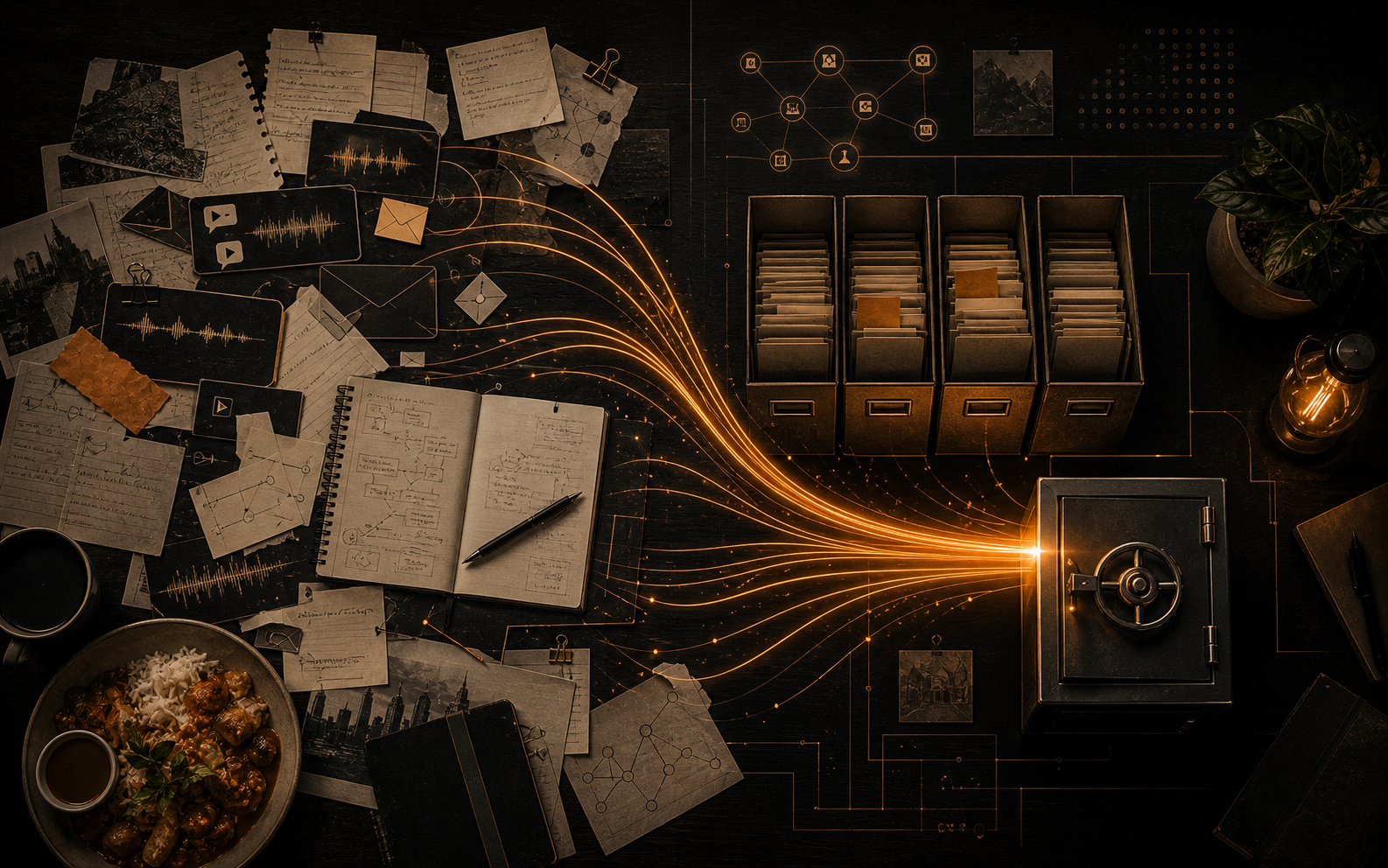
Five years ago, at a community meetup called Entrepreneurs Inlet, I met a designer named Tarang Sanghi.
What got me wasn't his work. It was how he ran his life. The man had a system for everything. Ideas, projects, notes, knowledge, all organized like a studio instead of the mental junk drawer the rest of us live out of. I'd genuinely never watched anyone think that cleanly.
He's the one who introduced me to the idea of a second brain, the PARA method: Projects, Areas, Resources, Archives. I got curious enough that I went and bought the bible, Tiago Forte's Building a Second Brain. I read it. I believed it.
And then I did nothing with it for half a decade.
Not because I was lazy. Well, not only because I was lazy. The tools weren't ready. You can't build a brain that remembers everything when your apps don't talk to each other, your AI can't actually do anything, and every system needs you to manually feed it like a houseplant. I didn't want a second brain I had to babysit. I wanted one that worked while I lived.
So I waited. For years. For the tech to grow up.
The first attempt: Glitchowt
Exactly one year ago, I stopped waiting and tried to force it.
Four of us teamed up at the 100x Engineers Buildathon, India's big generative-AI hackathon, and started a little thing called Glitchowt. The vision was the exact one I'd carried for years: a second brain that captures every conversation you have and actually remembers it for you.
Here's how that hackathon actually went. Day one, we did what every team does. We fought. Loudly. About what to even build.
Day two, our one real developer showed up for exactly two hours. He was also a DJ with a gig on day three, so the clock was tight. In those two hours he sketched the entire technical architecture, because the man is a legitimate genius, and then left to go prep his set.
So the marketers built the app.
Non-coders, one year ago, shipping a working AI application in under twelve hours. It pulled every email out of your Gmail, read them, figured out what actually mattered, and called you when something needed you. A brain with one ear and a phone, and we built it ourselves while our developer was off choosing tracks.
Then the next day, we all went to his party. It worked well enough to get us into the semifinals.
And then I hit the wall I'd been dreading. The AI just hadn't progressed far enough. MCP didn't exist yet, so there was no clean way for tools and models to actually plug into each other. To build the full vision then, I'd have been duct-taping for months and still ending up with something brittle.
So I made the unsexy call. I parked it. Not killed, just parked. Waiting for the tech to catch up to the idea.
This year, the idea took one lunch break
This year, on an actual lunch break, it finally clicked. The part the four of us broke our heads on a year ago, the genuinely hard part, wasn't mine to solve anymore. The big companies had already solved it. Models can act now. The tools finally talk to each other. Every piece I'd been waiting on had quietly shipped while I wasn't looking.
All that was left was making the connections.
So I opened a doc and started writing a prompt. By the time my food went cold, it was done. No team, no twelve-hour sprint, just a prompt wiring together what the platforms had already built.
And this time, it didn't stop at Gmail.
I wired in everything. Gmail and WhatsApp for the messages. Notion and Obsidian as the vault. And it runs between my AIs. A thread I start with Claude shows up with full context inside Codex on ChatGPT, and back again. The thing that took a whole team a frantic half-day became a one-person, one-lunch build.
Every conversation I have with a human, and every conversation I have with an AI, now lives under one roof.
And this is the part I'd waited years for: every new query I ask already carries all of that context. The AI never starts from zero. It knows what I discussed yesterday, with whom, in which app. In a small but real way, I've solved the context problem. For me, at least.
It's a Jarvis-styled second brain, one that doesn't just remember everything, it actually does something about it. The memory was always the easy half. The acting was what I'd been waiting on.
That's not a flex about me. It's a flex about the timing. The tools finally grew up. MCP arrived. Models got good enough to act, not just chat. The wiring I'd waited half a decade for quietly showed up, and what was impossible at a hackathon became a thing I do between meetings.
Now every conversation I have, with AI and with humans, gets captured and filed in PARA. Nothing lives only in my head anymore.
If PARA is new to you, here's the whole system in four lines:
- Projects: what I'm actively working to finish, with a deadline.
- Areas: ongoing responsibilities I maintain, with no end date.
- Resources: topics I'm collecting reference material on for later.
- Archives: anything from the other three that's done or dormant.
The brain I bought the book for in 2021 finally exists. It just needed the world to catch up.
So what does it actually do for me?
It's the co-founder I don't pay
Every voice note, half-idea, client thread, and "wait, that's a good line" lands in one system.
Ideas don't die from being bad. They die from being forgotten.
The vault is the net under the trapeze, so I can be reckless with ideas all day knowing nothing falls through.
AI is the intern, not the oracle
Most people ask AI for the answer and ship it, which is how everyone who used the same prompt ends up sounding identical. I run ideas through it to find what doesn't work. Bad outputs say "not this," which drags me toward this. The grunt work is the machine's. The judgment stays mine.
Systems beat willpower, every time
I don't show up consistently because I'm disciplined. I have the discipline of a Labrador near a samosa. I show up because the work flows through rituals whether I feel like it or not. When everything's a system, "not in the mood" stops being a valid excuse.
The lesson I keep relearning: sometimes the idea isn't wrong, the timing is. I sat on this one for five years and through a whole startup before the world was ready for it. Then it took a lunch break.
Knowing which of your parked ideas just became buildable might be the most valuable thing the second brain remembers for me.
The output of all of it, the work, the writing, the receipts, lands at That Hyperactive Sardar. The engine room just makes sure it ships.
A thank-you is owed here.
None of this starts without Tarang Sanghi, the friend and mentor who, five years ago at Entrepreneurs Inlet, showed a younger, messier me that a life could be organized in the first place. He planted the seed. AI just finally let it grow. If you want to see what a genuinely well-organized mind looks like, a designer, builder, and one of the sharpest systems-thinkers I know, go spend time on tarangsanghi.com.
I write more of these in Hyperthoughts. Culture, AI, craft, and the future of the work. From Dubai.
Abhileen Singh Saluja · That Hyperactive Sardar Find me: Website · Instagram @abhileen.ai · LinkedIn · Reach out
Originally published on Mataroa.